

McManus Insights
Volatility from IRA’s Part D Benefit Design Reforms Expose Manufacturer to Risk and Liability
By John McManus
Although average Part D beneficiary premiums remained stable between 2026 and 2027, this masks the underlying fundamentals of the program, which are deteriorating with dramatically escalating costs, substantial plan withdrawals, and widely variable premiums among plans. This volatility is largely due to the significant and disruptive changes the Inflation Reduction Act made to plan design and will likely fuel calls for further Part D reforms, which could expose pharmaceutical manufacturers to considerable liability and/or risk.
This memo provides analysis of the impact of the IRA Part D redesign reforms and how they resulted in such volatility and looks forward to potential threats to the pharmaceutical industry as Congress will inevitably re-examine the program. Specifically, the cost escalation and pending premium spike in 2030 could lead Congress to consider two policies that would adversely impact the pharmaceutical industry:
Substantially increasing manufacturer liability within the Part D benefit, currently set at 10% in the initial benefit and 20% in the catastrophic phase (A proposal floated in the Senate Finance Committee Majority RFI);[1]
A CMS-run plan with government price setting authority that would compete with existing private prescription drug and Medicare Advantage plans.
Finally, the memo suggests several alternative market-based reforms that could address current distortions caused by the IRA.
Summary
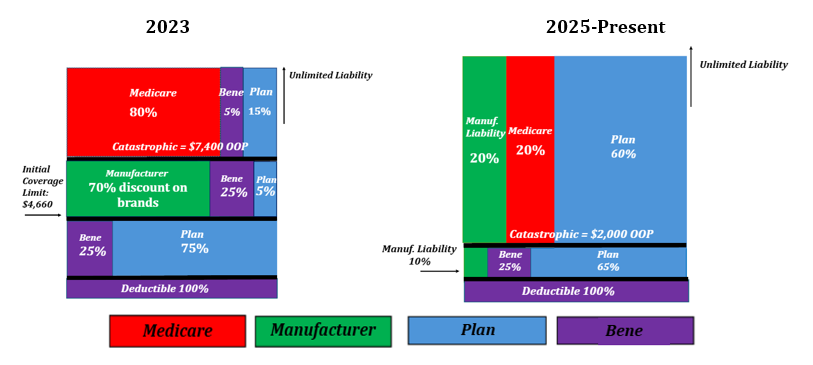
Part D Benefit Redesign Substantially Transferred Risk from Reinsurance to Plans
Impact of Redesign on National Average Monthly Bid Amount
Although only 4 percent (1.5 million) of non-LIS beneficiaries reach the catastrophic phase,[2] 43 percent of the costs in the Part D drug benefit were in the catastrophic phase prior to enactment of the IRA.[3] The IRA transferred risk and liability from Medicare “reinsurance,” which historically covered 80 percent of costs in the catastrophic phase, to prescription drug plans (PDP) and Medicare Advantage plans. As a result, the plan liability quadrupled from 15 percent of the catastrophic benefit historically to 60 percent almost overnight.[4] (Relatedly and inversely, reinsurance dropped from 80% in 2024 to 20 percent in 2025, with absolutely no phase-in.)
In addition, the catastrophic threshold was substantially lowered in 2025 to $2,000 in out-of-pocket spending, further increasing the actuarial value of the benefit covered by plans, with the catastrophic phase comprising 66 percent of the value of the benefit in 2025.[5]
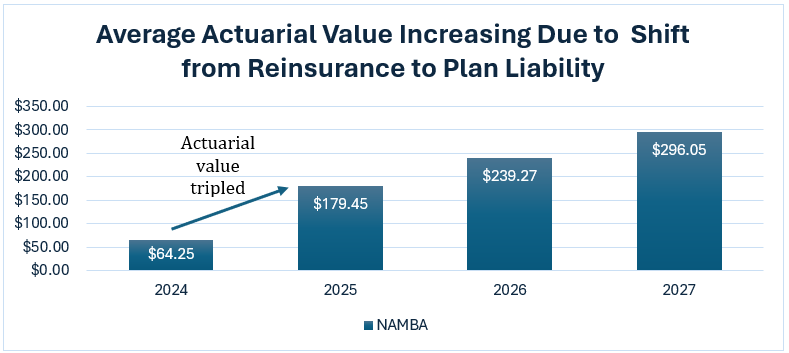
Due to these IRA benefit design changes, the national average monthly bid amount (NAMBA) nearly tripled in actuarial value from $64.25 in 2024 to $179.45 in 2025, with no phase-in. MedPAC acknowledged, “In 2025 most of the increase was attributed to the IRA’s shift in benefit financing.”[5] Costs have continued to escalate since then. From 2025 to 2026, the NAMBA increased by about 33%, from $179.45 to $239.27.[6] It will increase by about 24% in 2027, from $239.27 to $296.05.[7] The cost escalation in recent years (2026 and 2027 projections) reflects pharmaceutical cost growth, driven in part, by dampened incentives to control costs, as described below.
Premium Increases Explained
Historically, premiums for Part D plans have equaled 25.5 percent of the weighted-average cost of the plan-covered cost. Market dynamics worked to contain premiums because beneficiaries had to pay the full amount for plan bids that exceed the weighted average cost. In addition, plans also had incentives to bid low because Low-Income Subsidy (LIS) beneficiaries’ subsidies were capped at the weighted average cost; they could not be auto-enrolled in plans with higher costs.
However, the IRA introduced several new concepts that substantially disrupted and undermined these competitive dynamics.
The substantially greater plan actuarial value would have commensurately increased premiums -- doubled or tripled orders of magnitude -- with no intervention. Therefore, the architects of the IRA included a 6 percent year-to-year cap on average beneficiary premiums in that law. (Premiums to individual plans can still rise far more, as the cap is only applicable to the market average.)
This cap undermined plan incentives to contain costs, as it eliminated any market penalty for large cost increases and associated premium increases.
The $2,000 cap on beneficiary out-of-pocket costs also undermined formulary management by making it impossible for plans to signal preference for cheaper products through cost variation to enrollees.
Viewing the statutory 6 percent annual cap to mitigate premium increases as insufficient to ensure premium stability, the Biden Administration announced in July 2024 the Premium Stabilization Demonstration Program applicable to PDPs only, which:
Reduces the monthly base beneficiary premium by $15 for all participating stand-alone PDPs (cannot be less than $0);
Imposes a year-to-year $35 increase limit on a plan’s total Part D premium; and
Allows CMS to adjust the risk corridors for greater government risk-sharing to cover plan losses.
The Medicare Payment Advisory Commission estimates the subsidy program reduced the average Part D plan premium by about 40% in 2025. This year, it cut the average rate by an estimated 27%. MedPAC estimates the cost of the demonstration to be $10.7 billion for 2025 and 2026.5 These arbitrary premium protections undermined the competitive market by providing inefficient plans more subsidies than efficient plans and helped delink the premiums from the cost of the plans.
Earlier this year, the Trump Administration announced it was terminating that demonstration program, and it would not be effective in the 2027 plan year. The 6 percent statutory cap still applies until 2030. The Administration touted that the average premium would remain stable; however, this assumes beneficiaries will switch into cheaper plans. As the Paragon Health Institute observed, premiums in stand-alone plans are slated to go up by nearly 50 percent in 2027 ($33 to $49 a month), which will cause enormous turbulence even if beneficiaries do indeed switch plans:[8]
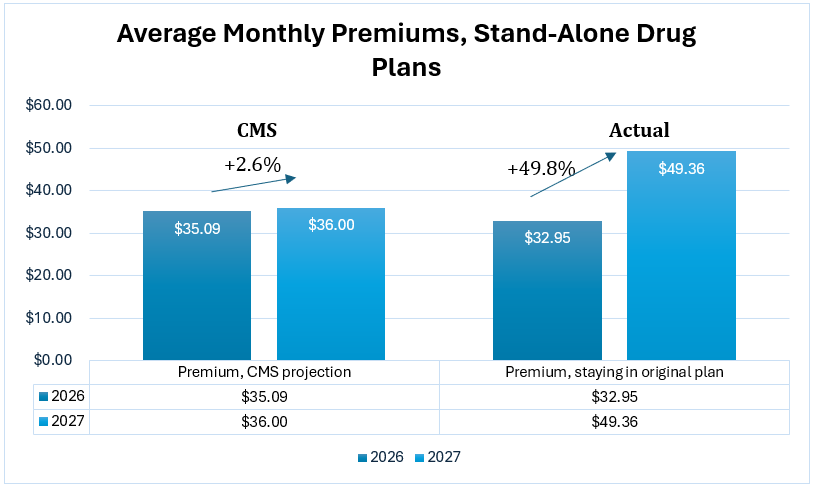
Additionally, the multi-year 6 percent annual premium cap has resulted in a substantial cost-shift from beneficiaries to the Medicare program/taxpayers as the portion of the benefit paid by the average beneficiary has dropped to just 11 percent of the basic benefit cost in 2025, down from the historical 25.5% prior to IRA enactment![8] In contrast, Part B has a 25% premium, and A&B have combined a 15% premium. Without the multi-year premium cap, the national premium amount would have been $94 in 2027 rather than $36. The Part D premium percentage in 2027 is likely in single digits.
The 6 percent annual basic growth cap is set to expire at the end of 2029, and premiums will rise sharply in 2030 when that temporary premium constraint expires. The IRA establishes a new beneficiary premium amount for the basic benefit of 20 percent in 2030. While that amount is down substantially from the historical 25.5% established in the Medicare Modernization Act and lasting through 2023, it will still result in tremendous premium increases because it will be more than double the basic premium percentage. This means premium costs will explode in 2030, absent a legislative change. The American Enterprise Institute projects an 84%-111% premium increase to maintain current benefits.[9] This looming premium spike is likely to provoke congressional action.
A November 2025 blog post, “A Call for New Research in the Area of Spending on Medicare Part D | Congressional Budget Office,” elaborates on this recent cost growth. CBO notes, “From 2017 to 2022, annual growth in projected per-enrollee costs for Part D plans with the basic benefit ranged from a 5 percent reduction to a 4 percent increase. Since then, those projections have increased substantially: by 20 percent in 2024, 42 percent in 2025, and 35 percent in 2026.”[11] CMS now projects a 24 percent increase to NAMBA in 2027. It is important to note that the IRA was enacted in 2022, and these growth rates are compounding upon each other.
CBO attributed this substantial increase to several factors:
Beneficiaries’ response to reductions in cost sharing
IRA capped beneficiary OOP spending, resulting in higher submitted bids for 2025 than anticipated.
CBO underestimated the impact of manufacturer patient assistance programs.
Market-wide trends in drug spending
Savings from IRA drug negotiations were less than anticipated in previous estimates in 2024 & 2025 and would be fully offset by continued growth in spending on diabetes/weight management drugs (GLP-1s).
Prescription drug spending grew 11.4% in 2025, up from 4.9% in 2023.
Higher overhead costs for insurers
Insurers are building higher profit margins and administrative costs into bids, growing from 6.5% to 11.4% of net costs.
Less competition and instability in Part D stand-alone market.
Uncertainty about tariff policy could lead insurers to preemptively build costs into bids.
Administrative actions
CMS Part D Demonstration capped monthly premiums for stand-alone drug plans at $35 year-over-year increase, undermining competition and incentives to control costs.
CBO: “If insurers expect admin actions to shield enrollees from the full impact of increased premiums, they may be less constrained in submitting bids with higher costs. Those bids may persist over time if insurers expect the subsidies to recur.”
Part D Costs Have Exploded and Are Projected to Keep Rising
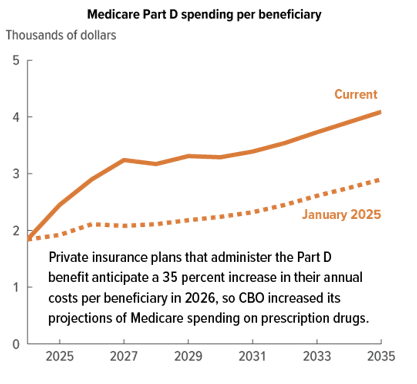
In February 2026, CBO updated its cost projections for the Part D Program, estimating a 35%, or $700 billion, increase in Part D projected spending between 2026 and 2035.[10]
PDP Market Deterioration
The number of stand-alone PDP plans offered has decreased by nearly 60% since the IRA was enacted. Notably, plan availability has fallen by half from 2024 to 2026 (709 plans to 360). The number of premium-free benchmark plans for low-income subsidy beneficiaries dropped from 8 to 2 in that same period.[12]
These recent declines have been most pronounced among enhanced plans—those that offer benefits that are more generous than the standard Part D benefit design—as enhanced plan offerings have fallen by 60 percent (443 plans to 177) over the same period. All told, the number of stand-alone plans is down more than 80% since enactment, from 1,866 in 2007 to just 360 plans today.[12]
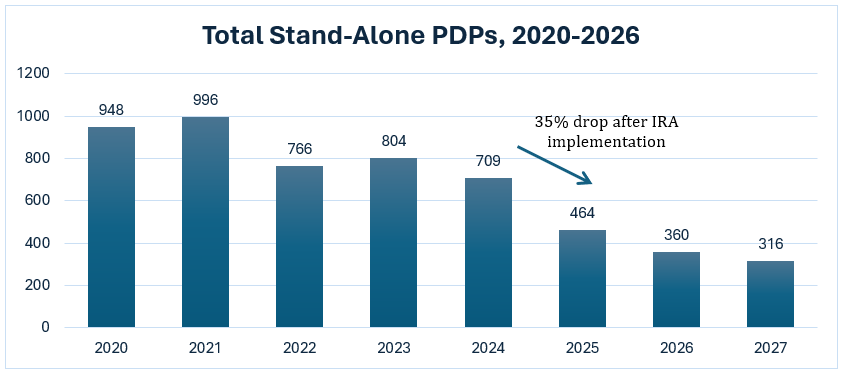
Part of the stand-alone PDP market deterioration can be explained by movement toward Medicare Advantage, as those integrated plans have more tools available to contain premiums than stand-alone PDPs with greater formulary compliance with doctors on contract and the ability to shift resources from Parts A & B medical benefit. However, the dramatic collapse of the stand-alone market is cause for concern as Part D is founded on the principle of competition and choice to contain costs. In September 2025, 96 percent of PDP members were enrolled in plans offered by the top five carriers (Wellcare, CVS/Aetna, UnitedHealthcare, Humana, and HealthSpring). The largest—Wellcare—enrolled 44 percent of all PDP members.[1] Fewer plans further consolidate payer power and are likely to lead to more restrictive formularies and less product coverage.
Additionally, plan choice collapse has fueled calls for a government-run stand-alone plan. The Arnold Foundation recently published an article in Health Affairs: “An Old Idea whose Time Has Come: Why Medicare needs a Federal Backstop for Part D,” arguing for CMS to sponsor a plan that would compete with private plans:[14]
PDPs are losing market share to Medicare Advantage; PDPs are pulling out of the market and in a “death spiral.”
PDP risk pool is getting smaller and more expensive.
Plans are absorbing increased risk-sharing that the structure was not built for.
The article suggests using demonstration authority to skirt the statutory prohibition on CMS-run fallback plans, which are limited to a market region where no PDP plans exist. It concludes, “Federal negotiating power has the potential to strengthen the probability of favorable pricing, depending on the final design of such a plan, including the extent of CMS’s role in design and operational administration.”
A CMS-run PDP could presumably use a new fee schedule for drug reimbursement developed by CMS and thereby subject all brand-name drugs (regardless of time on the market, as currently required by the IRA) to HHS “negotiation.”
Beneficiary Out-of-Pocket Liability Decline
While the trends on costs, plan choice and looming premium spikes are concerning, a bright spot is the IRA’s plan redesign’s impact on beneficiary out-of-pocket spending, which results from the substantially lower catastrophic threshold and the elimination of the 5 percent coinsurance in that phase, as demonstrated by the chart below by MedPAC.[5]
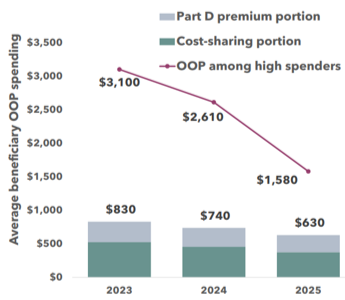
From 2023-2025, OOP spending declined by 25%, or $200, on average, with cost sharing declining by 30%. 5 Further, OOP spending declined by 50% among high-spending enrollees while program spending per enrollee increased by 30%.[5]
This reduction in out-of-pocket liability has improved drug adherence. Nonadherence in Part D was 8.2% in the three years prior to IRA implementation and then fell to 5.7% in 2024.[15] However, zero copays in the catastrophic phase has helped undermine formulary tools and fueled costs, according to CBO.
Aspects of the benefit redesign in the IRA have dramatically fueled cost increases and led to instability in the Medicare Part D market. Costs continue to dramatically escalate, the breadth of plan withdrawals is concerning, and premiums, while temporarily restrained, are set to explode in 2030 when the 6 percent year-to-year cap on the benchmark premium expires. All these dynamics are likely to compel further Congressional action, perhaps as soon as next Congress. Such reforms are likely to generate more exposure, liability, and risk for the pharmaceutical industry, including increased manufacturer liability, more drugs being subject to negotiation (and sooner), and a potential CMS-run PDP.
We are working to develop market-based reform ideas that generate savings through competitive dynamics rather than further price controls, which only cause distortions. These include.
Modest copays in the catastrophic phase to improve formulary tools and drive market share to cheaper drugs within a therapeutic class (e.g., $5 generic, $10 preferred brand, $25 non-preferred brand);
The point is not to increase beneficiary liability but to encourage them to choose cheaper drugs, which now appear free to them.
Reformed bidding incentives for LIS beneficiaries to drive lower bids and reward efficient plans with more market share;
The LIS premium subsidy is capped at the weighted average bid, which encourages plans to shadow price that anticipated benchmark. More competitive bidding could be incentivized by awarding all or a substantial portion of auto-assigned dual eligible beneficiaries to the cheapest plan or cheapest two plans.
In 2030, gradually reduce plan liability by increasing reinsurance in the catastrophic to a more manageable threshold, which will also reduce premiums commensurately.
Develop policy and actuarial analysis supporting point-of-sale rebates that would be achieved at the pharmacy counter for copayments in the deductible and/or the initial benefit phase.
We believe CBO fundamentally mis-scored the Part D rebate during Trump 1, and real-world experience and actuarial analysis could be presented to show this will increase competition and reduce costs rather than increase costs.
Conclusion
References
“Request for Information: Commonsense Policy Options to Lower Drug Prices for Patients,” Senate Finance Committee Minority Staff, June 16, 2026. https://www.finance.senate.gov/imo/media/doc/061626_sfc_drug_pricing_rfi.pdf
Bisma A. Sayed et al., “Inflation Reduction Act Research Series—Medicare Part D Enrollee Out-of-Pocket Spending: Recent Trends and Projected Impacts of the Inflation Reduction Act,” ASPE Office of Health Policy, January 30, 2024. https://aspe.hhs.gov/sites/default/files/documents/1b652899fb99dd7e6e0edebbcc917cc8/aspe-part-d-oop.pdf
Aditi P. Sen et al., “Catastrophic Coverage in the Medicare Part D Drug Benefit: Which Beneficiaries Need It and How Much Are They Spending?,” The Commonwealth Fund, September 17, 2020. https://www.commonwealthfund.org/publications/issue-briefs/2020/sep/catastrophic-coverage-medicare-part-d-drug-benefit
Plan liability increased to 20 percent for one year (2024) when the 5 percent beneficiary coinsurance was eliminated after $8,000 of out-of-pocket spending.
Shinobu Suzuki and Betty Fout, “Issues and Potential Policy Directions in Part D,” Medicare Payment Advisory Commission, September 3, 2026. https://www.medpac.gov/wp-content/uploads/2026/09/Tab-C-Part-D-Sept-2026.pdf
“2026 Medicare Part D Bid Information and Part D Premium Stabilization Demonstration Parameters,” Centers for Medicare & Medicaid Services, July 28, 2025. https://www.cms.gov/newsroom/fact-sheets/2026-medicare-part-d-bid-information-and-part-d-premium-stabilization-demonstration-parameters
“Medicare Part D 2027 National Average Monthly Bid Amount Information,” Centers for Medicare & Medicaid Services, July 28, 2026. https://www.cms.gov/newsroom/fact-sheets/medicare-part-d-2027-national-average-monthly-bid-amount-information
Boris Vabson, “Beyond Part D’s Flat Premium Headline: The IRA Is Driving a Deteriorating Market,” Paragon Health Institute, October 6, 2026. https://paragoninstitute.org/paragon-prognosis/beyond-part-ds-flat-premium-headline-a-deteriorating-market/
Benedict Ippolito, “The Uncertain Future of Medicare Part D and Options for Reform,” American Enterprise Institute, September 10, 2026. https://www.aei.org/research-products/report/the-uncertain-future-of-medicare-part-d-and-options-for-reform/
“The Budget and Economic Outlook: 2026 to 2036,” Congressional Budget Office, February 2026. https://www.cbo.gov/publication/62105#_idTextAnchor246
Tamara Hayford and Asha Saavoss, “A Call for New Research in the Area of Spending on Medicare Part D,” Congressional Budget Office, November 21, 2025. https://www.cbo.gov/publication/61824
Juliette Cubanski, “A Current Snapshot of the Medicare Part D Prescription Drug Benefit,” Kaiser Family Foundation, October 7, 2025. https://www.kff.org/medicare/a-current-snapshot-of-the-medicare-part-d-prescription-drug-benefit/
Dylan Collin et al., “Continued Concentration and Sustained Stabilization: A 2026 Medicare Prescription Drug Plan Market Overview,” Milliman, October 24, 2025. https://www.milliman.com/en/insight/concentration-stabilization-medicare-pdp-2026
Emma Finestone and Kristi Martin, “An Old Idea Whose Time Has Come: Why Medicare Needs a Federal Backstop for Part D,” Health Affairs, September 11, 2026. https://www.healthaffairs.org/content/forefront/old-idea-whose-time-has-come-why-medicare-needs-federal-backstop-part-d
Lucas Marinacci et al., “Cost-Related Medication Nonadherence After the Inflation Reduction Act,” JAMA Internal Medicine, March 9, 2026. doi:10.1001/jamainternmed.2026.0012